✦ Core Takeaway & Wisdom
“The three granthis invite us to recognise fear, attachment and ego within ourselves. Spiritual growth begins when we bring awareness into everyday choices—building security with wisdom, loving with freedom and learning with humility”
“तीन ग्रन्थियाँ हमें अपने भीतर के भय, मोह और अहंकार को पहचानने की प्रेरणा देती हैं। आध्यात्मिक विकास तब शुरू होता है, जब हम दैनिक जीवन में विवेक से निर्णय लेते हैं, प्रेम में स्वतंत्रता देते हैं और विनम्रता से सीखते हैं।”
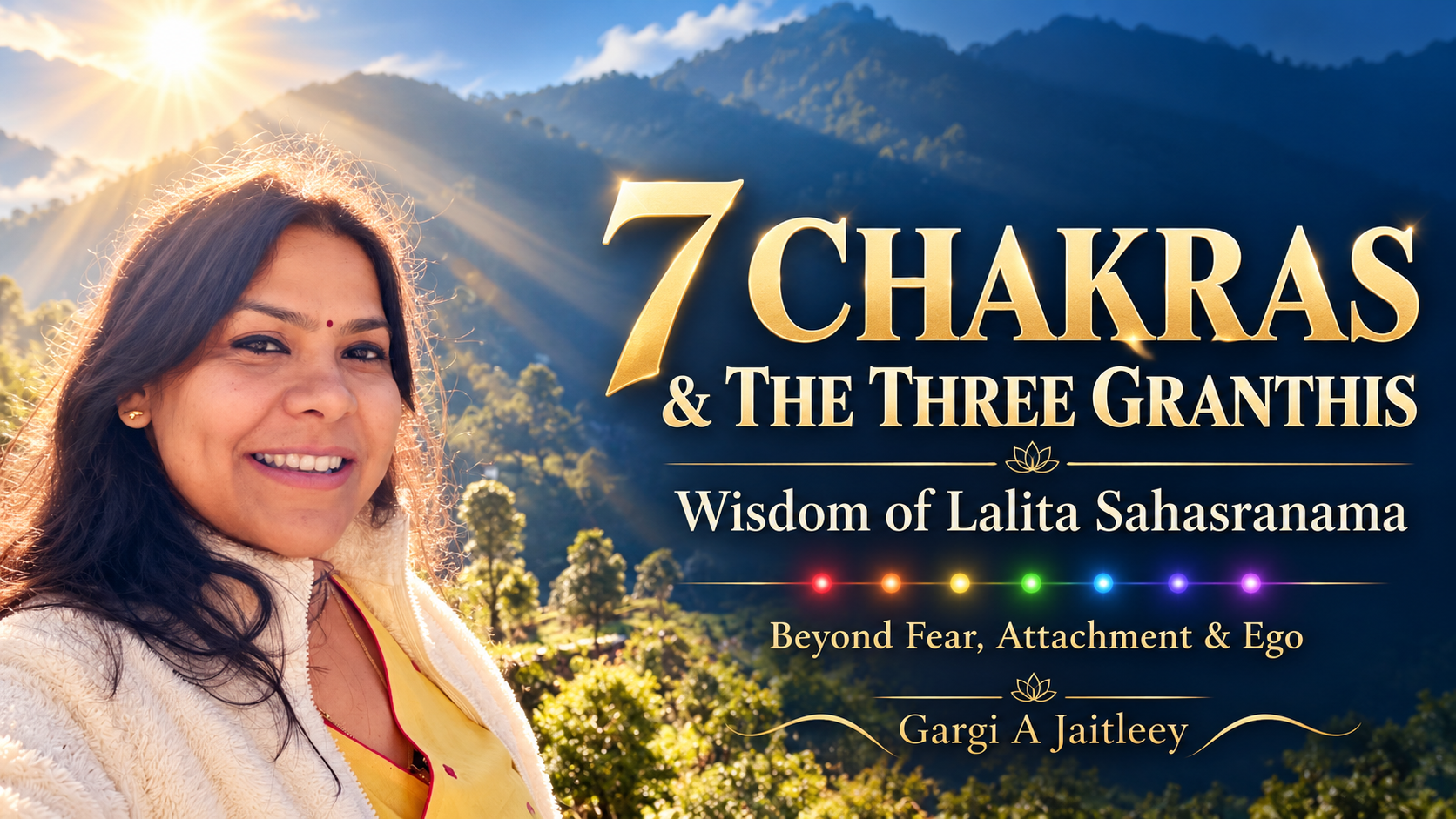
Explore Lalita Sahasranama, chakras and the three granthis through Gargi A Jaitleey’s reflections on Kriya Yoga Diksha, Rishikesh and Babaji’s cave.
The Sacred Journey Within: Untying the Three Knots of Fear, Attachment and Ego
Reflections on Kriya Yoga Diksha, Rishikesh and Mahavatar Babaji’s Cave
By Gargi A Jaitleey
Spiritual Healer & Astrologer | Astrology for Health, Wealth and Mind
You can travel far from home and still carry the same worries with you.
The unfinished work. The uncertain future. The relationship you keep replaying in your mind. The feeling that you must remain strong, useful and available to everyone.
During my journey of Kriya Yoga Diksha, my time in Rishikesh, and my visit to Mahavatar Babaji’s cave near Kukuchina, in the Dunagiri region of Uttarakhand, I carried a question within me:
What does it truly mean to become free from our inner knots?
We visit sacred places seeking blessings, guidance and peace. Alongside that outer journey, there is an invitation to examine what we carry within: our fears, expectations, attachments and deeply held ideas about who we are.
A sacred journey can become a beginning—a willingness to see ourselves more honestly and bring that awareness home.
The words of the Lalita Sahasranama offer a beautiful way to explore this inner journey:
Brahma-granthi-vibhedini.
Vishnu-granthi-vibhedini.
Rudra-granthi-vibhedini.
The Divine Mother is praised as the one who pierces the three spiritual knots.
But what might these teachings help us understand about an ordinary day—earning a living, raising children, caring for our health, loving someone or receiving criticism?
That is where this reflection begins.
The Prayer Behind the Teaching
The Shri Lalita Sahasranama Stotram praises Maa Lalita Tripurasundari. This passage describes Her through the spiritual imagery of Kundalini, the chakras and the unfolding of consciousness:
मूलाधारैकनिलया ब्रह्मग्रन्थिविभेदिनी ।
मणिपूरान्तरुदिता विष्णुग्रन्थिविभेदिनी ॥
आज्ञाचक्रान्तरालस्था रुद्रग्रन्थिविभेदिनी ।
सहस्राराम्बुजारूढा सुधासाराभिवर्षिणी ॥
तटिल्लतासमरुचिः षट्चक्रोपरिसंस्थिता ।
Its simple meaning is:
Sacred name | Simple meaning |
|---|---|
Mooladharaika-nilaya | She who dwells in the Muladhara. |
Brahma-granthi-vibhedini | She who pierces the Brahma knot. |
Manipurantarudita | She who arises within Manipura. |
Vishnu-granthi-vibhedini | She who pierces the Vishnu knot. |
Ajna-chakrantaralastha | She who abides within the Ajna chakra. |
Rudra-granthi-vibhedini | She who pierces the Rudra knot. |
Sahasrarambujarudha | She who is seated upon the thousand-petalled lotus. |
Sudhasarabhivarshini | She who showers the essence of nectar. |
Tatillata-samaruchih | She whose radiance resembles a streak of lightning. |
Shat-chakropari-samsthita | She who is established above the six chakras. |
We can contemplate this passage as a prayer:
“Maa, help me recognise the bonds that limit my awareness. Guide me towards greater clarity, freedom and love.”
Text reference: Shri Lalita Sahasranama
What Is an Inner Knot?
The Sanskrit word granthi means knot.
In this context, it refers to a subtle spiritual concept. Different yogic traditions explain the locations and characteristics of the granthis somewhat differently. The everyday examples below use these teachings as a reflective lens; they are not literal translations of the Sanskrit names.
Imagine a necklace tangled inside a jewellery box.
The thread is still there. The beads remain beautiful. Yet a small knot prevents everything from moving freely. Pulling impatiently can make it tighter.
We can experience something similar within ourselves.
We may have the ability to love, yet react with control. We may have knowledge, yet struggle to listen. We may have resources, yet feel constantly unsafe.
Understanding the knot begins with noticing the thought beneath our reaction.
Brahma Granthi: “Will I Be Safe?”
Through the lens of Brahma Granthi, we can examine our attachment to physical security, possessions, comfort and familiarity.
Food, shelter, income and stability are real needs. Caring about them is responsible. The difficulty begins when we expect complete certainty before allowing ourselves to live.
The inner voice says:
“Once everything is secure, I will relax.”
But the finish line keeps moving.
There is always another expense, another possibility to worry about, another reason to postpone rest.
When fear starts making our decisions
Consider a woman who wants to begin meaningful work. She has experience and a promising idea, but she keeps waiting until there is no possibility of failure.
Her caution could help her prepare. Instead, it prevents her from taking even a small, manageable step.
Now consider someone who rushes into every opportunity because they fear being left behind.
Their behaviour looks different, but both may benefit from the same question:
“Am I responding to the facts, or trying to escape a feeling of fear?”
This question brings us back to practical responsibility.
We can review costs. We can ask for advice. We can start small. We can acknowledge uncertainty without allowing it to make every decision.
A practice for steadiness
Write down four things:
What is the actual problem before me?
What resources do I have?
What information am I missing?
What is one manageable action I can take today?
Then take that action.
It may be finishing a proposal, reviewing an expense, making an appointment or asking for help.
Let your reflection become a sentence you can live:
“I can care for my future through the action available to me today.”
Vishnu Granthi: “Will I Still Be Loved?”
Through the lens of Vishnu Granthi, we can explore emotional attachment—especially our expectations within relationships.
We want to be loved, understood and valued. These are deeply human wishes.
Sometimes, however, an unspoken condition enters our love:
“If you love me, you should behave as I expect.”
A disagreement begins to feel like rejection. Someone’s need for space feels like abandonment. A loved one’s independent decision feels like a statement about our importance.
Recognising this can be uncomfortable. It can also create room for a more honest relationship.
The silent agreement behind overgiving
A person keeps saying yes, even when exhausted.
Inside, they hope:
“After everything I do, surely they will understand what I need.”
But the need remains unspoken. When others fail to recognise it, resentment grows.
Before agreeing to something, we can ask:
“Am I choosing this freely? What do I need to express?”
A clear request might be:
“I would appreciate your help. Can we share this responsibility?”
A boundary might be:
“I care about you. I can listen this evening, but I need to rest now.”
These simple sentences allow care and honesty to exist together.
Motherhood and the courage to allow growth
As a mother, I find this teaching especially meaningful.
Watching a child become independent can bring pride, tenderness and the ache of being needed differently.
We can lovingly ask ourselves:
“How can I help my child become capable while remaining a dependable presence?”
The answer will change with the child’s age and needs. There will be moments for guidance, protection, encouragement and stepping back.
We do not need to criticise ourselves for finding this difficult. Awareness gives us an opportunity to respond with greater care.
A practice for relationships
Choose one relationship in which you feel repeatedly disappointed.
Complete these sentences:
“I keep expecting…”
“What I actually need is…”
“What I have not clearly expressed is…”
“What is within my control is…”
Choose one respectful conversation or boundary.
The teaching becomes useful when it changes how we speak, listen and care.
Rudra Granthi: “Who Am I Without This Identity?”
Through the lens of Rudra Granthi, we can examine our attachment to identity, certainty and the sense that “I know.”
This knot can be difficult to recognise because it may appear within our strengths.
Knowledge can make us less willing to listen. Success can make us afraid of appearing inexperienced. Spiritual practice can become something we feel we must prove.
The inner voice says:
“If I admit I was wrong, people will lose respect for me.”
Or:
“I help everyone else. I should be able to handle this alone.”
But experience does not remove our need to learn or receive support.
When a meaningful role becomes pressure
A healer may feel she must always be peaceful.
An astrologer may feel she must have every answer.
A teacher may feel uncomfortable becoming a student again.
For me, an important question is:
“Can I remain devoted to my work while staying open to correction?”
There is strength in saying:
“I need to examine this more carefully.”
“I had not considered that perspective.”
“I made a mistake, and I will correct it.”
These words allow our understanding to develop.
A practice for humility
The next time feedback makes you defensive, pause.
Ask:
“What part of this can I examine honestly?”
Listen before preparing your reply.
You may still disagree. Listening gives you a better basis for that disagreement—and sometimes an opportunity to discover something useful.
Bringing the Teaching into Health, Wealth and Mind
My work as a spiritual healer and astrologer centres on Health, Wealth and Mind.
For me, spiritual reflection becomes valuable when it helps us participate more consciously in these everyday areas.
Area of life | A thought worth examining | A useful next step |
|---|---|---|
Health | “Rest makes me less productive and less worthy.” | Make room for appropriate rest and care. |
Wealth | “I must act immediately or lose my only chance.” | Review the facts, costs and options. |
Relationships | “Their disagreement means they do not value me.” | Ask what they mean and explain your needs. |
Mind | “One mistake proves I am incapable.” | Identify what needs correcting and take one step. |
Spiritual practice | “My experience makes me superior.” | Return to service, humility and learning. |
These questions support reflection. A health condition or financial difficulty does not establish that a spiritual knot is blocked. Appropriate healthcare and practical financial planning remain essential.
Spiritual language should help us understand ourselves with compassion.
Where Astrology Fits into This Journey
My guiding belief is:
Astrology should create awareness, preparedness and transformation.
A meaningful consultation should help a person consider their choices with greater clarity.
Alongside questions about timing, I want us to explore:
What can you prepare for?
Which habit deserves attention?
What support do you need?
What action is available to you now?
Astrology can offer a spiritual framework for reflection. It cannot establish a medical diagnosis or guarantee financial success. Our choices, circumstances and appropriate professional support all matter.
I want people to leave with a stronger sense of participation in their own lives.
Bringing the Sacred Journey Home
Kriya Yoga Diksha, time in Rishikesh and a visit to Babaji’s cave can hold profound personal meaning.
There is also a quiet question to carry home:
“How will I practise this awareness in the next ordinary moment?”
Perhaps it will mean listening patiently when someone disagrees.
Perhaps it will mean taking a necessary step despite uncertainty.
Perhaps it will mean admitting that you are tired and accepting help.
These moments may seem small, but they are places where our intentions become behaviour.
Specific Kriya Yoga techniques belong within the guidance of one’s initiation and qualified teacher. The reflection shared here is an invitation to observe our daily patterns.
Five Minutes of Honest Reflection
At the end of the day, sit comfortably and allow your breathing to remain natural.
Ask yourself:
Where did fear make a decision for me today?
Where did an unspoken expectation affect my relationship?
Where did I defend my image before listening?
Choose one answer.
Then write:
“Tomorrow, I will practise…”
Keep the action small enough to do.
You might ask one clear question, complete one avoided task or receive one suggestion without interrupting.
You can close with a prayer:
Maa, help me see what I am holding too tightly.
Give me steadiness where I feel afraid.
Give me understanding where I feel hurt.
Give me humility where I feel certain.
Help me bring awareness into the life I am living.
The Thread Is Still Whole
Some patterns once helped us cope.
Staying alert may have helped during uncertainty. Pleasing others may have protected an important connection. Appearing confident may have helped us carry responsibility.
We can acknowledge that history while asking whether the same pattern still serves us.
A knot asks for patience and careful attention.
The three granthis offer questions we can return to throughout life: How do I build security? How do I love? How do I remain open to learning?
My sacred journey gives me a personal setting in which to contemplate these questions. Their practice continues in daily life—in the next decision, the next conversation and the next opportunity to choose with awareness.
You do not have to untangle your whole life today. Notice one knot. Meet it with honesty. Take one wiser step.
Gargi A Jaitleey
Spiritual Healer & Astrologer
Astrology for Health, Wealth and Mind
Apply this wisdom to your personal Kundli
Schedule a 1-on-1 private reading with Gargi A Jaitleey to examine how these planets and nakshatras affect your career, marriage, and health.
✦ Gargi Academy of Vedic Sciences
Master the Art of Prediction with Structured Practical Training
Explore our 9 specialized courses from Foundation to Advanced Predictive Jyotish.