✦ Core Takeaway & Wisdom
“You are more than your physical body. Explore how the five koshas invite care for your body, breath, emotions, wisdom and spiritual wellbeing alongside medical care.”
“आपका अस्तित्व केवल शरीर तक सीमित नहीं है। पंचकोश हमें चिकित्सा देखभाल के साथ शरीर, श्वास, भावनाओं, विवेक और आध्यात्मिक जीवन पर ध्यान देना सिखाते हैं।”
Explore the five koshas, seven chakras and medical astrology with Gargi A Jaitleey. Discover practical ways to nurture body, breath, mind and inner wellbeing.
Pancha Kosha and Medical Astrology: Bringing Vedic Wisdom into Everyday Wellbeing
By Gargi A Jaitleey
Medical Astrologer | Vedic Astrologer | Spiritual Healer
When people come to me for a medical astrology consultation, they often bring more than a question about physical health. They bring worries, difficult experiences, unanswered questions and a desire to understand themselves.
Sometimes, beneath their concern, lies a deeper question:
“How can I care for my whole being—physically, emotionally and spiritually?”
I am Gargi A Jaitleey, a Medical Astrologer, and my work is rooted in faith in Vedic scriptures and the wisdom of our spiritual traditions. I believe in karma, rebirth and the influence of past-life impressions. My modern viewpoint explores how we can apply this inherited knowledge thoughtfully in everyday life.
One framework that helps us explore this is Pancha Kosha—the five sheaths of human experience.
It invites us to look at the body, breath, mind, discernment and inner contentment together.
Karma, Illness and the Possibility of Conscious Action
A traditionally quoted Sanskrit verse expresses a karmic understanding of illness:
जन्मान्तरकृतं पापं व्याधिरूपेण बाधते।
तच्छान्तिरौषधैर्दानैर्जपहोमसुरार्चनैः॥
Janmāntara-kṛtaṃ pāpaṃ vyādhi-rūpeṇa bādhate;
Tacchāntir auṣadhair dānair japa-homa-surārcanaiḥ.
Traditional meaning: “Wrongdoing from a previous birth afflicts one in the form of illness; its alleviation is sought through medicines, charity, mantra repetition, homa and worship.”
The verse circulates in different forms, and its precise original textual attribution remains uncertain. Here, I present it as a traditionally quoted verse rather than attribute it to a particular Vedic passage.
What draws my attention is the range of support it names:
Sanskrit term | Meaning | Application in everyday life |
|---|---|---|
Aushadha | Medicine | Seeking appropriate treatment and following professional advice |
Dana | Charity | Practising generosity and service within one’s means |
Japa | Sacred repetition | Maintaining a steady, meaningful mantra practice |
Homa | Sacred fire offering | Participating in a religious practice with appropriate guidance |
Surarchana | Worship of the Divine | Cultivating devotion, gratitude and spiritual connection |
Medicine has an explicit place alongside spiritual practice.
My belief in karma encourages responsibility for present actions. Whatever we believe about the origins of suffering, we can ask: What can I do today to live more consciously, seek support and care for myself and others?
It also calls for compassion. A person’s illness does not give us grounds to judge their past or measure their spiritual worth. Medical astrology cannot establish that a particular illness is the result of a particular past-life action.
Samskaras: Understanding the Patterns We Carry
In spiritual traditions, samskaras are understood as impressions that influence our tendencies, responses and habits.
We can explore this idea through familiar experiences:
Repeated criticism may contribute to a habit of doubting ourselves.
A painful relationship may leave us expecting rejection.
A life organised around constant achievement may make rest feel uncomfortable.
Repeatedly avoiding difficult conversations may become an automatic response.
From my spiritual perspective, working with samskaras means becoming aware of these patterns and choosing how to respond.
This does not mean that every difficult emotion creates a disease. Nor does it mean that emotions become physical deposits inside a particular kosha.
There is, however, a recognised relationship between prolonged stress and physical wellbeing. Stress can contribute to or worsen digestive difficulties, headaches and sleep problems. These relationships are complex, and illness has many possible causes.
Awareness gives us an opportunity to change a habit, seek help or respond with greater care.
What Is Pancha Kosha?
The foundation of the five-kosha teaching appears in the Taittiriya Upanishad, within the Vedic tradition. It describes progressively inward dimensions associated with food, vital breath, mind, understanding and bliss. Later Vedantic teaching develops these as the five sheaths.
These are dimensions through which we experience life, rather than five separate anatomical bodies.
Kosha | Meaning | Everyday focus |
|---|---|---|
Annamaya Kosha | Food sheath | Nourishment, movement, rest and physical care |
Pranamaya Kosha | Vital-energy sheath | Breath, vitality and the balance between activity and rest |
Manomaya Kosha | Mental sheath | Thoughts, emotions and habitual reactions |
Vijnanamaya Kosha | Discernment sheath | Understanding, beliefs, values and conscious choices |
Anandamaya Kosha | Bliss sheath | Inner contentment, devotion and spiritual connection |
In my approach, cleansing the koshas means refining habits, cultivating awareness and creating conditions for greater balance. It is an ongoing spiritual practice.
1. Annamaya Kosha: Nourishing the Body That Carries You
Anna means food. Annamaya Kosha brings our attention to the physical body, which depends on nourishment and daily care.
We may spend time worrying about health while overlooking basic needs: regular meals, sufficient sleep, suitable movement or a medical appointment we have postponed.
Caring for this kosha begins with listening.
Practical ways to care for Annamaya Kosha:
Eat regular, nourishing meals suited to your individual needs.
Maintain cleanliness and a manageable daily routine.
Choose movement appropriate to your health and ability.
Allow time for sleep and recovery.
Attend medical appointments and follow prescribed treatment.
Bathing cleans the skin. Movement supports physical function. Neither requires a claim that sweat removes accumulated emotional or karmic toxins.
Ask yourself: “What does my body need that I have been postponing?”
The grounding symbolism of Muladhara Chakra can complement this reflection. However, Annamaya Kosha includes the entire physical body.
2. Pranamaya Kosha: Listening to the Breath
Pranamaya Kosha concerns prana, the vital principle described in yogic tradition. Breath offers an accessible way to explore this dimension.
Notice what happens during a stressful moment. You may hold your breath, tighten your chest or begin breathing rapidly. Becoming aware of this can create a pause before your next response.
Prana is a spiritual concept; it should not simply be equated with oxygen or a measurable electrical field.
Practical ways to explore Pranamaya Kosha:
Observe natural breathing for a few minutes.
Allow the breath to remain comfortable and unforced.
Take brief pauses between demanding activities.
Learn pranayama from a qualified teacher who understands your health needs.
Balance exertion with recovery.
Beginners should avoid forceful breathing and prolonged breath retention. Pregnancy and some health conditions require individual modifications.
Ask yourself: “Am I giving myself room to pause?”
The chest location of Anahata Chakra makes it a useful focus for breath awareness, although Pranamaya Kosha is not restricted to one chakra.
3. Manomaya Kosha: Understanding Thoughts and Emotions
Manomaya Kosha concerns the mind, including feelings, thoughts and our responses to experience.
Many people try to become positive before acknowledging what hurts. Yet understanding often begins with an honest statement:
“I feel afraid.”
“I am grieving.”
“I need support.”
Mantra, prayer and devotional singing can give attention a steady focus. Journaling, supportive relationships and counselling can help us understand experiences that remain difficult.
Practical ways to care for Manomaya Kosha:
Practise a familiar mantra with attention and devotion.
Name your feelings without criticising yourself.
Write down recurring thoughts.
Notice the effect of your daily media consumption.
Seek professional support when distress persists or affects daily life.
Ask yourself: “What feeling needs to be heard?”
Different chakra themes can support this enquiry: Manipura for confidence, Anahata for connection and grief, and Vishuddha for expression. Emotional life cannot be confined to one centre.
4. Vijnanamaya Kosha: Questioning the Beliefs That Guide Us
Vijnanamaya Kosha concerns discernment and understanding.
Sometimes, the belief beneath a habit needs attention:
“I must please everyone.”
“If I rest, I am lazy.”
“Because something went wrong before, it will always go wrong.”
Discernment allows us to pause and ask whether a conclusion is accurate, helpful or consistent with our values.
For me, spiritual knowledge becomes practical when it influences our choices—how we speak, set boundaries, accept help and respond to uncertainty.
Practical ways to explore Vijnanamaya Kosha:
Study a passage from the Bhagavad Gita or another trusted text.
Reflect on how it applies to a current situation.
Separate facts from assumptions.
Question rigid beliefs with kindness.
Choose one action that reflects your values.
Ask yourself: “Am I making a conscious choice or repeating an old response?”
The symbolism of Ajna Chakra, associated with insight and perspective, offers a useful thematic connection.
5. Anandamaya Kosha: Discovering Contentment Within
Anandamaya Kosha is associated with bliss. In spiritual enquiry, this points towards an inward dimension beyond our usual pursuit of achievement and satisfaction.
We can approach this through devotion, meditation, gratitude and moments of quiet presence.
Surrender does not require abandoning action. It can mean doing what is necessary while acknowledging that every outcome is not within our control.
You can pray sincerely and continue treatment. You can feel gratitude while also acknowledging pain.
Practical ways to explore Anandamaya Kosha:
Sit quietly without demanding a special experience.
Offer a sincere prayer.
Notice a moment of beauty or connection.
Practise service within your capacity.
Allow yourself to rest without needing to earn it.
Ask yourself: “Can I take today’s next step without carrying the entire future?”
Some contemporary teachings connect this inward dimension with Sahasrara. This is an interpretive association rather than a universal kosha–chakra pairing.
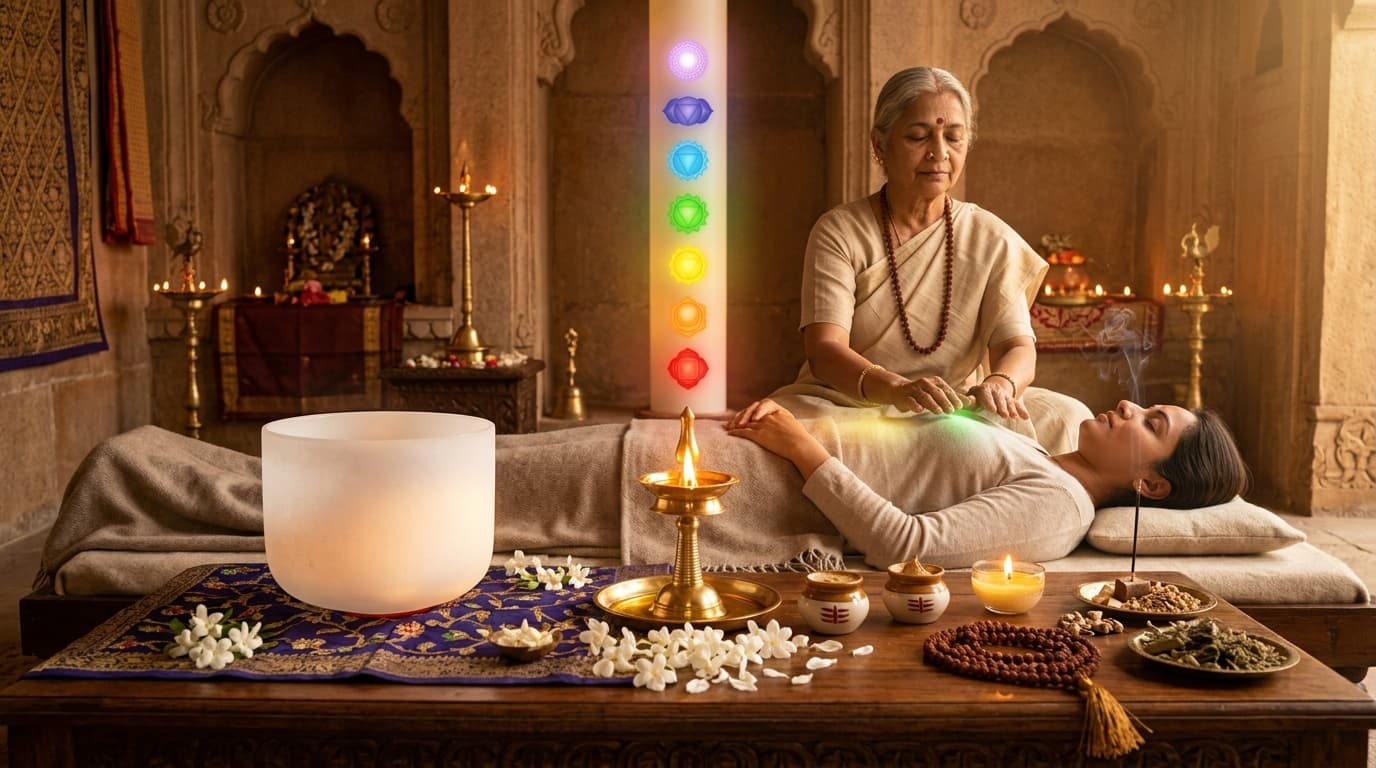
Five Koshas and Seven Chakras: How Do They Connect?
The koshas and chakras are different spiritual maps.
Koshas describe dimensions of experience. Chakras describe centres within yogic subtle-body teachings. They can be explored together, but there is no universally accepted one-to-one correspondence.
A familiar seven-centre presentation places the chakras from the base of the spine to the crown. Traditions vary in their descriptions and interpretations.
The following table offers spiritual themes and examples of health concerns sometimes associated with these regions in contemporary chakra literature. These associations do not establish the cause of a disease or provide a diagnosis.
Chakra | Spiritual themes | Body region commonly associated | Health concerns sometimes linked in contemporary chakra literature | Practical exploration |
|---|---|---|---|---|
Muladhara — Root | Stability, safety and belonging | Pelvic base, lower spine and legs | Constipation and lower-back discomfort | Build dependable routines; explore suitable walking and grounding awareness. |
Svadhisthana — Sacral | Creativity, pleasure and emotional flexibility | Pelvis and reproductive region | Menstrual difficulties, pelvic pain and sexual-health concerns | Explore creativity, emotional expression and healthy boundaries. |
Manipura — Solar Plexus | Confidence, agency and purposeful action | Navel and upper abdomen | Indigestion and digestive complaints | Establish regular meals and practise small, achievable decisions. |
Anahata — Heart | Connection, compassion and grief | Chest | Heart and respiratory conditions | Seek emotional connection and grief support alongside appropriate medical care. |
Vishuddha — Throat | Expression, listening and truthfulness | Throat and neck | Voice difficulties, neck tension and thyroid disorders | Practise clear communication and attentive listening; seek assessment for persistent symptoms. |
Ajna — Brow | Discernment, attention and perspective | Brow and head | Headaches, eye strain and sleep difficulties | Take screen breaks, examine assumptions and practise comfortable meditation. |
Sahasrara — Crown | Spiritual connection and meaning | Crown of the head | Some modern charts assign neurological or mental-health conditions here; these links are not medically established | Explore prayer, meaning and service while seeking professional care for symptoms. |
Grief does not establish the cause of heart disease. Difficulty speaking openly does not establish the cause of thyroid disease. Fertility difficulties do not show that someone has failed spiritually.
Spiritual reflection should deepen compassion and support appropriate care.
Where Medical Astrology Fits into My Approach
As a medical astrologer, I use astrology as a traditional interpretive framework for spiritual reflection.
A consultation can create space to discuss routines, recurring concerns, personal meaning and spiritual practices. A horoscope cannot diagnose a disease, confirm that an organ is affected or establish a past-life cause of illness.
My intention is awareness, preparedness and thoughtful action.
When a person has symptoms, appropriate medical assessment remains essential. Spiritual practices can accompany that care and offer meaning, steadiness and connection.
This is how I bring a modern viewpoint to inherited wisdom: by asking what practical support a person needs now.
Why Caring Across the Five Koshas Can Be Valuable
A nourishing meal meets a physical need. A supportive conversation addresses a different need. Prayer may offer courage. Clear medical guidance may help someone make an informed decision.
One practice does not have to perform every role.
There is also no requirement to cleanse all five koshas before medical treatment can work. The value of the framework lies in helping us notice more of the person’s experience.
Someone receiving treatment may also need better sleep, help managing responsibilities, emotional support and a spiritual practice that feels reassuring. These forms of care can work alongside one another.
Yoga and related practices may support some symptoms and aspects of wellbeing, although benefits and safety depend on the practice and the individual.
A Simple Daily Pancha Kosha Practice
Begin gently. Choose actions you can sustain.
Dimension | A small daily action |
|---|---|
Annamaya — Body | Meet one physical need: nourishment, rest, suitable movement or medical care. |
Pranamaya — Breath | Observe five comfortable breaths without forcing or holding them. |
Manomaya — Mind | Name one feeling and write a compassionate response to it. |
Vijnanamaya — Discernment | Question one assumption and choose one thoughtful action. |
Anandamaya — Inner connection | Spend a quiet moment in prayer, gratitude or stillness. |
These are invitations to care for yourself, rather than measures of spiritual achievement.
Ancient Wisdom in Real Life
I believe the value of spiritual knowledge becomes visible in how we live.
Does it help us become more compassionate? Does it encourage responsibility? Does it help us seek support, care for the body and respond more wisely to difficulty?
My faith in karma encourages me to pay attention to present action. My understanding of Pancha Kosha encourages me to listen to the whole person.
Care for the body that carries you. Give your breath room to settle. Allow your feelings to be heard. Develop discernment. Make space for devotion and inner quiet.
This is the spirit in which I bring Vedic wisdom into everyday wellbeing—with faith, practical action, medical care and compassion.
Gargi A Jaitleey
Medical Astrologer | Vedic Astrologer | Spiritual Healer
9315116755
Apply this wisdom to your personal Kundli
Schedule a 1-on-1 private reading with Gargi A Jaitleey to examine how these planets and nakshatras affect your career, marriage, and health.
✦ Gargi Academy of Vedic Sciences
Master the Art of Prediction with Structured Practical Training
Explore our 9 specialized courses from Foundation to Advanced Predictive Jyotish.